GALIUM DIVARICATUM
Including:- Galium parisiense
Family and Genus:- See- RUBIACEAE/Sect. KOLGYDA
Common Names:- None
Homotypic Synonyms:- None
Meaning:- Galium (Gr) Milk.
Divaricatum (L) Wide-spreading, straggling, divaricate.
General description:- Very slender divaricately branched annual.
Stems:-
1) (5-) 10-25 cm, erect, glabrous or minutely aculeolate on the angles.
Leaves:-
1) 4-10 x 0·3-1·5(-2) mm, in whorls of 6-8, narrowly lanceolate to linear, antrorsely
scabridulous on the margins, with short hyaline arista.
a) upper, often slightly hispid, above.
2) Margin, and midrib antrorsely scabrid, not or slightly revolute.
Flowers:-
1) Inflorescence, lax, broadly ovoid.
2) Partial inflorescences, with 5-13 flowers at the 2 nodes below the central flower.
3) Peduncles, 5-20 mm, (2-)3-7(-10) times as long as the pedicels.
4) Pedicels, 0·5-2·5 mm, filiform, somewhat deflexed after anthesis.
5) Corolla, 0·5-1 mm diam, cupuliform, glabrous, yellowish-red.
a) lobes, ovate, scarcely apiculate.
Fruit:-
1) Mericarps, c. 0.7 mm, broadly reniform, glabrous, tuberculate.
Key features:-
1) Peduncles, 3-7 times as long as the pedicels.
2) Pedicels, filiform, somewhat deflexed after anthesis.
Habitat:- Dry open shrubby vegetation, dry grassland and other open habitats. 0-
1200 m.
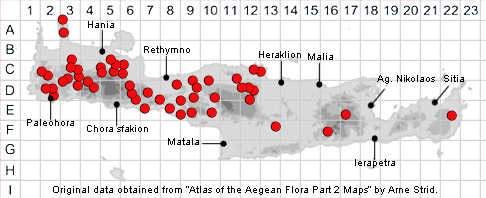
Distribution:- Scattered throughout mainland Greece, S. and C. parts of Europe,
extending eastwards to W.Syria and Lebanon. Widespread in the W & C Crete with
a few scattered localities in the east.
Flowering time:- Apr-June(-July)
Photos by:- Fotis Samaritakis
SPECIES DESCRIPTION
~~~~~~~~~~~~~~~~~~~~~~~~~~~~~~~~~~~~~~~~~~~~~~~~~~~~~~~~
GALIUM PARISIENSE Back to Back
Homotypic Synonyms:- Aparine parisiensis, Aparinella parisiensis. Galium
anglicum subsp. parisiense, Galium gracile var. parisiense, Galium parisiense
var. trichocarpum
Meaning:- Parisiense (L) French.
Resembling Galium divaricatum, but differing in the following characters:-
1) Often taller and somewhat more robust.
2) Stem, sparsely but distinctly retrorsely aculeolate.
3) Peduncles, c. twice as long as the pedicels.
a) both somewhat thickened in fruit.
4) Mericarps, c 1 mm, reniform, usually with uncinate bristles.
Habitat:- Dry grassland, mixed scrub and open woodland, 0-1100 m, on various
substrates.
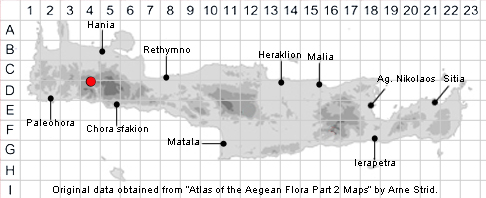
Distribution:- Widespread in W & S Europe and the Mediterranean region
eastwards at least to S Anatolia. On Crete currently known from only one location.
Flowering time:- May-June, occasionally later.